Yes. Singapore law doesn't keep will writing for lawyers. The Legal Profession Act leaves wills out of the documents only a lawyer may draw up for a fee, and the Ministry of Law says "Will-writing services are not restricted solely to lawyers". I'm a financial adviser representative, and I write first wills, priced by quote.
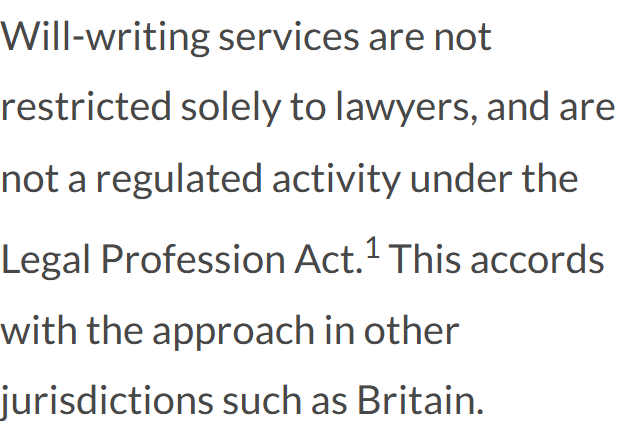
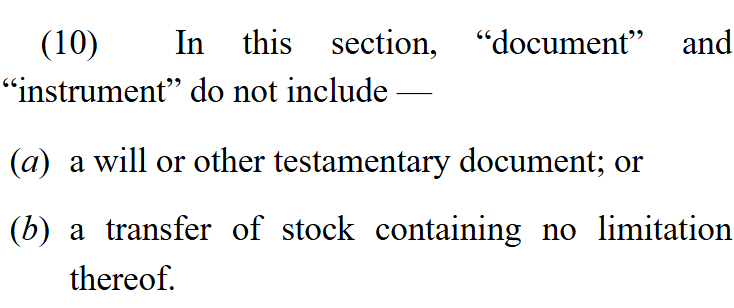
On 15 November 2026, Google's AI answer to this question said advisers "typically partner with specialized will-writing companies", and ChatGPT's said yes, "provided they offer will-writing services".
The rules a will has to follow
Who drafts it doesn't decide whether it's valid. The Wills Act does, and its rules are short.
Age
You're 21 or older. The only exception is for soldiers on active service and seamen at sea.
Writing
The will is in writing, printed or by hand.
Signing
You sign at the end, in front of two witnesses who are there at the same time.
Witnesses
Both witnesses then sign, in front of you.
A gift in the will to a witness, or to a witness's husband or wife, is void for that person, unless two other witnesses also signed, and the rest of the will still stands. So it's best that neither witness, nor their husband or wife, is someone the will leaves anything to.
A will is revoked by a later will, by a signed and witnessed writing that revokes it, or by destroying it on purpose. Marriage revokes a will too, unless the will says it was made with that marriage in mind. Separation and divorce don't automatically revoke it, LifeSG says, and neither does a change in your circumstances on its own.
Where a lawyer comes in
The Ministry of Law said in July 2026 that anyone 21 or older and of sound mind "may write his or her own will, or engage a third party, to assist with its preparation". MAS said in May 2024 that will writing with no financial advice in it isn't regulated under the Financial Advisers Act, and that any financial advice given alongside it must follow that Act.
Some work stays with lawyers. The Ministry of Law said in October 2025 that businesses running wills and probate courses, unless run by a lawyer, "cannot give legal advice and cannot provide the services of an advocate and solicitor". Preparing the papers for a grant of probate, for a fee, is reserved for lawyers under the Legal Profession Act. LifeSG says: "A lawyer is not legally required, but consulting a lawyer for legal advice is strongly recommended." The Ministry of Law's own advice is to consult a lawyer for complicated arrangements.
What a will can't reach
Covered by your will?
Where it goes instead
Your own property, bank accounts and investments
Yes
Where your will says
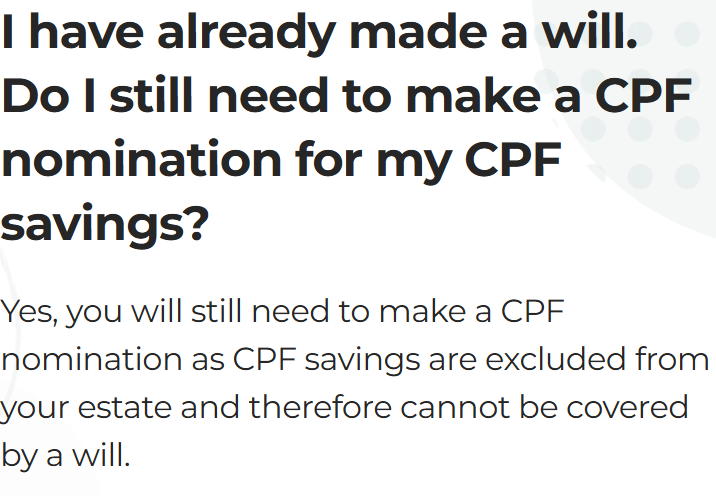
CPF savings
No
By CPF nomination. CPF: "cannot be covered by a will"
A home held as joint tenants, or a joint bank account
No
To the surviving joint owner
Insurance with a trust (irrevocable) nomination
No
To the people named, outside your estate
A revocable insurance nomination is the exception. Under the Insurance Act, a later will can revoke it, if the will deals with all the policy's death benefits and names the policy in the way MAS sets out.
For Muslims, the Administration of Muslim Law Act sets the rules, and MUIS explains them. A wasiat can give up to a third of your assets, and only to people who don't inherit under faraid. Faraid decides the rest.
If there's no will
The Intestate Succession Act decides who gets what, for anyone who isn't Muslim.
The spouse, when there are children
The children, shared equally
With a spouse and no children or parents, the spouse gets everything. With a spouse and parents but no children, the spouse gets half and the parents share the other half.
A made-up example: Daniel and Mei
Daniel and Mei are a made-up couple. Daniel wrote a will in 2020, leaving everything to his parents, and he made a CPF nomination for them the same year. He married Mei in 2024, and they had a son.
The marriage revoked his will, because it didn't say it was made with this marriage in mind. CPF says marriage also revokes a CPF nomination. So if Daniel died today, the Intestate Succession Act would split his estate, half to Mei and half to their son. His CPF would go to the Public Trustee, which distributes it under the same law after an administrative fee, and CPF says finding the eligible family can take up to six months.
Nothing Daniel did was wrong. His plan only needed one new will and one new CPF nomination after the wedding.
Where to keep it
The Singapore Academy of Law runs the Wills Registry. It records where your will is kept, and it holds the will itself only if you deposit a digital copy. A record costs $50 to deposit and $10 to search, and it's optional. Through a participating law firm, you can deposit a digital copy at no charge until 31 March 2027, though the signed paper will is still the one that counts.
The LPA and the AMD
A will speaks after you're gone. A Lasting Power of Attorney (LPA) lets someone you choose make decisions for you if you lose mental capacity. Since 1 April 2026, LPA Form 1 has been free for Singapore citizens. You still pay the certificate issuer: the median Form 1 fee among the doctors on OPG's list of its 20 most visited certificate issuers was $47.50 as at June 2025, before consultation and GST.
An Advance Medical Directive (AMD) records that you don't want extraordinary life-sustaining treatment if you're terminally ill and unconscious. MOH says it's made through a doctor, with two witnesses, and you don't need a lawyer. It takes effect once it's registered. My team runs LPA and AMD sessions with a doctor regularly, and they cost you nothing.

My family checklist goes through the CPF steps, nominations, the will and the LPA. The family checklist
Sources
- Google's AI Overview and ChatGPT search for "Can a financial adviser in Singapore write my will?", captured 15 Nov 2026
- Wills Act 1838, sections 4, 6, 10, 13, 14, 15 and 27, current version at 15 Nov 2026
- Legal Profession Act 1966, section 33, current version at 15 Nov 2026
- Ministry of Law, written answer on the drafting of wills, 7 Oct 2019
- Ministry of Law, written reply on intestate deaths and will writing, 7 Jul 2026
- Ministry of Law, written answer on help for wills, 7 Jan 2025
- Ministry of Law, written reply on businesses providing will and probate courses, 15 Oct 2025
- MAS, parliamentary reply on financial advisers who advertise estate planning, 7 May 2024
- LifeSG, writing a will, last updated 5 Nov 2026
- LifeSG, wills, last updated 5 Nov 2026
- CPF Board, a will and a CPF nomination, last updated 18 Jun 2024
- CPF Board, making a CPF nomination, last updated 25 May 2026
- Insurance Act 1966, sections 132 and 133, current version at 15 Nov 2026
- Administration of Muslim Law Act 1966, sections 111 and 112, current version at 15 Nov 2026
- MUIS, wasiat, last updated 4 Sep 2026
- Intestate Succession Act 1967, sections 2 and 7, current version at 15 Nov 2026
- Singapore Academy of Law, Wills Registry, read 15 Nov 2026
- MSF, Lasting Power of Attorney, read 15 Nov 2026
- MSF, LPA fee for Singapore citizens, read 15 Nov 2026
- MSF, where to find a certificate issuer, read 15 Nov 2026
- MOH, Advance Medical Directive, last updated 7 Oct 2025
If you'd rather go through it with someone
Risk and financial planning with me starts with a financial audit. We go through what you already have, what's missing and the questions worth asking next. If you want advice after that, I'd do a full fact-find first, and only if you ask for one. There's no cost, and nothing changes unless you say so. I'm paid by commission or an ongoing fee if you buy anything through me, and I'll tell you that amount first, in dollars.
Lu Jia Jun · Financial Adviser Representative, GEFA · RNF No. LJJ300837068
I do not represent CPF Board, IRAS or any government agency. General information only, not financial advice.