Four numbers on your own papers decide it: what you'd get back today against what you've paid in, how many years of surrender charges are left, what your cover costs now at your age, and whether you still need that cover. And surrendering or keeping it as it is aren't the only two choices.
On 15 November 2026, Google's AI answer to this question said it "depends on how long you have held it", and cited none of MoneySense, MAS, the Life Insurance Association (LIA) or FIDReC, the dispute centre.
How an ILP spends your premium
An investment-linked policy (ILP) has life insurance and an investment part. MoneySense says your premiums buy units in a fund, and "Some of the units purchased are then sold to pay for insurance and other charges, while the rest remain invested". The charges include the cost of insurance, policy administration and fund management.
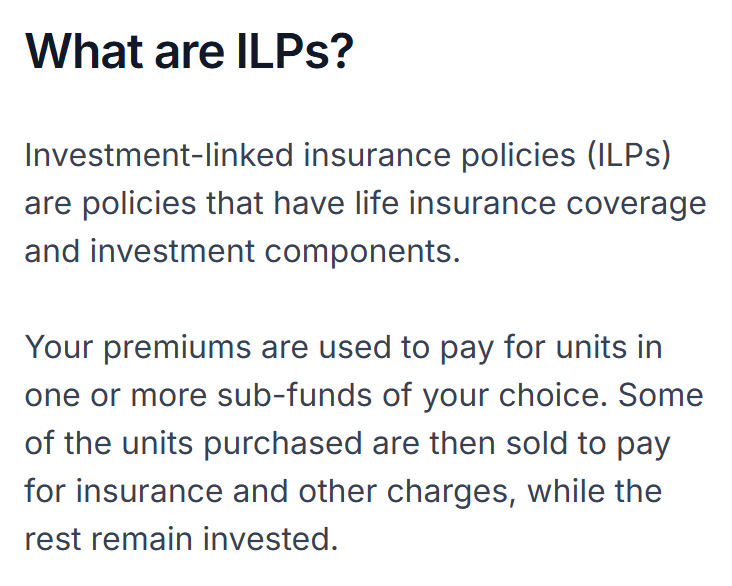
The cost of insurance "typically increases year on year" as you get older, even if your cover stays the same, so more units are sold to pay for it as the years go on. If your units can't keep up, MoneySense says you'll have to top up your premium or reduce your cover. ILPs usually have no guaranteed cash value.
Surrender charges in the early years
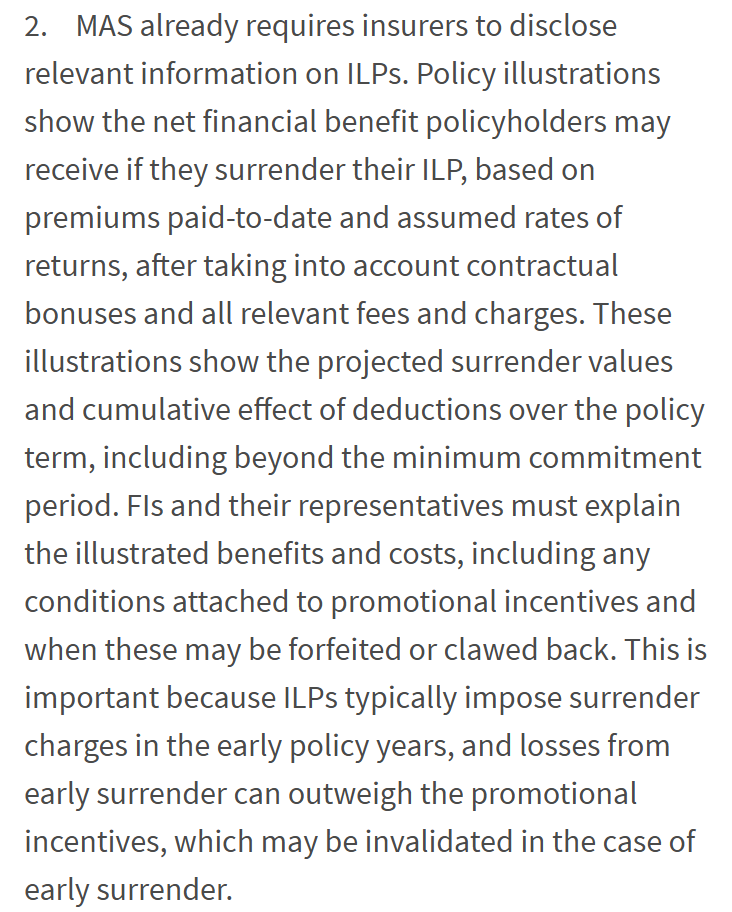
MAS said on 4 November 2026 that "ILPs typically impose surrender charges in the early policy years, and losses from early surrender can outweigh the promotional incentives". The LIA's own guide shows how one design works.
In year 1
In year 2
In year 3
From year 4
An example from the LIA's guide. Each policy sets its own charges and period, shown in its product summary and policy contract.
MAS has also said it will "shortly" bring in a Product Highlights Sheet for ILPs as a whole. Its draft template, from May 2026, would state the maximum charge for early surrender or partial withdrawal and how long it applies. It isn't in force yet.
The choices in between
What it does
What to watch
Switch sub-funds
Moves your units to a different fund
Most insurers give some free switches, then a small fee
Reduce your cover
Lowers the insurance charges taken from your units
Down to a minimum sum assured; raising it again needs underwriting
Partial withdrawal
Takes out part of the value
Charges can apply, and the units left must still carry the cover
Top up
Adds money to the units
A premium charge can apply to top-ups; check the product summary
Premium holiday, where allowed
Pauses premiums without ending the policy
Units keep being sold for charges, and there may be a fee
MAS puts the two sides plainly. People who surrender "may not be able to find a policy with similar coverage at the same cost", and "There are also situations where holding on to a life insurance policy no longer makes financial sense", such as having no dependants left.
A made-up example: Aisha, five years in
Aisha is a made-up example, and her numbers are made up too. She's 35 and has paid $30,000 into a regular-premium ILP over five years. Her yearly statement, which her insurer must send her at least once a year, shows a net cash surrender value of $26,500.
She works through the four numbers. What she'd get back is $3,500 less than she's paid in. Her policy contract shows the surrender charge runs for one more year. The statement shows what her insurance charges took this year. They rise with age, and her product summary sets out how they're charged. And she checks whether she still needs the cover: she has a young son, so she does.
With the charge ending next year and the cover still needed, she looks at the choices in between before surrendering: whether reducing the cover or switching sub-funds fits, and what each would cost on her own policy.
If it was sold badly
Speak to the insurer first. If you're not satisfied with its final reply, you can take it to FIDReC within six months of receiving that reply.
At FIDReC
In its own words
Cost to file
Free; adjudication has a case fee
"Filing a complaint is free of charge."
How much
No limit for mediation; adjudication up to S$150,000 a claim, for claims filed from 1 July 2024
"There is no claim limit for mediation at FIDReC"
What it decides
An adjudicator's decision binds the institution, and you're free to accept it or not
"final and binding on the financial institution, but not on you"
What it doesn't take
Investment performance, or fees and pricing, on their own
"cases relating solely to investment performance of a financial product"
MoneySense also says to report "Inappropriate or misleading advice", misrepresentation or a lack of disclosure to MAS, though MAS can't order the insurer to compensate you. Under MAS's rules, a representative needs a reasonable basis for any recommendation, and mustn't recommend switching you from one policy into another if it harms you, including through the penalty for ending it.
If you got your policy documents in the last 14 days, you can still cancel by written notice. For an ILP, the refund is adjusted for any change in the market value of the investments behind it, less medical and other costs.

My ILP fee audit checklist walks through your own statement line by line. The ILP checklist
Sources
- Google's AI Overview for "i was sold an ilp should i surrender or keep", google.com.sg, captured 15 Nov 2026
- MoneySense, understanding investment-linked insurance policies, last updated 28 Sep 2026
- MoneySense, ILPs: guide to fees and pricing, last updated 4 Nov 2026
- LIA, Your Guide to Investment-Linked Policies, Mar 2026
- MAS, written reply on ILP disclosures and welcome bonuses, 4 Nov 2026
- MAS, consultation response on Product Highlights Sheets, 15 May 2026
- MAS, reply on life insurance policies, 4 Jan 2021
- MAS, notice on recommendations on investment products, 29 Dec 2025
- MoneySense, resolving a dispute with a financial institution, last updated 4 Nov 2026
- FIDReC, FAQs and jurisdiction, read 15 Nov 2026
- MoneySense, interpreting your insurance documents, last updated 11 May 2026
If you'd rather go through it with someone
Risk and financial planning with me starts with a financial audit. We go through what you already have, what's missing and the questions worth asking next. If you want advice after that, I'd do a full fact-find first, and only if you ask for one. There's no cost, and nothing changes unless you say so. I'm paid by commission or an ongoing fee if you buy anything through me, and I'll tell you that amount first, in dollars.
Lu Jia Jun · Financial Adviser Representative, GEFA · RNF No. LJJ300837068
General information only, not financial advice.