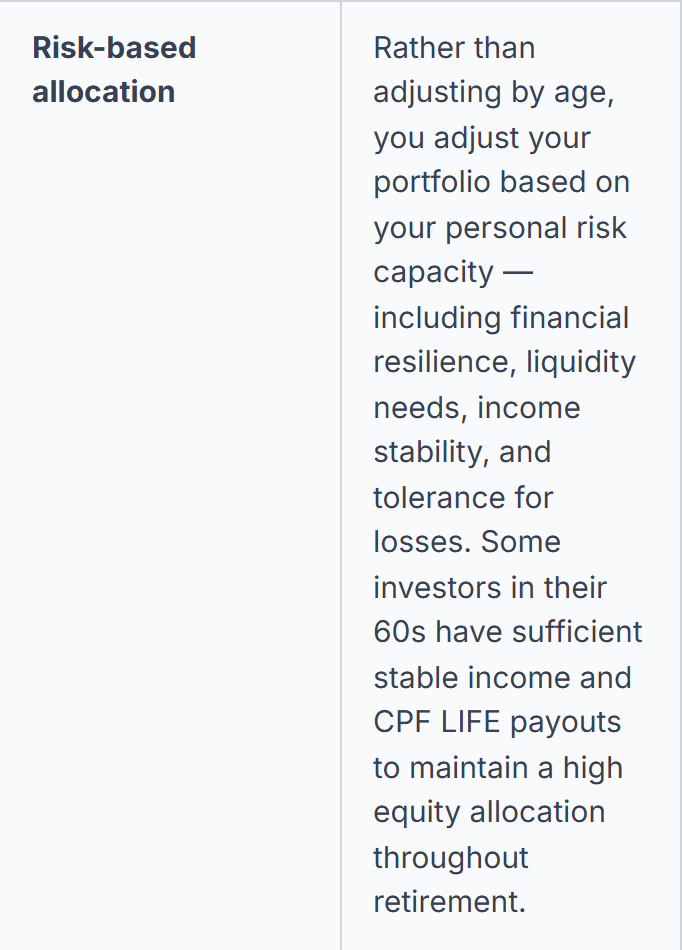
It can suit some people. MoneySense, the Government's money site, says "Some investors in their 60s have sufficient stable income and CPF LIFE payouts to maintain a high equity allocation throughout retirement." Its starting point is the more usual one, shifting "to lower-risk income assets as retirement approaches", and it says life-stage investing "is not one-size-fits-all". The step it gives is to set your projected CPF LIFE payouts against your monthly costs in retirement, to see the gap the rest of your money has to fill.
On 15 November 2026, Google's AI answer to this question said a 100% stock portfolio in retirement can give the biggest median ending balance and leaves you exposed to the order your returns arrive in, and it pointed to Scott Cederburg's research.
Why Jesse Cramer thinks the two goals split
Jesse Cramer, a US financial planner, thinks growing the biggest pot and making sure the money lasts are two different goals. He made the case on his podcast on 11 November 2026 with a basketball game. Your team is up by one point with 10 seconds left, and you have the ball. If you want the most points, you shoot. If you want to win, you hold the ball and let the clock run down.
In your 30s and 40s, he says, chasing growth and staying safe usually line up. As you start drawing on the money, more risk still raises the average result, and it also widens the range, with "higher highs" and "lower lows". That can raise your odds of running out before you die.
What the 100% stocks study found
Scott Cederburg and two colleagues wrote the paper both Jesse and Google's answer point to. In its December 2024 version, they used stock, bond and bill returns from 39 developed countries, some going back to 1890, up to 2023, and simulated a million working lives and retirements for each strategy.
The mix that came out best was one third home-market stocks and two thirds overseas stocks, with no bonds, held from the first pay cheque to the end. Their model is a US couple who save 10% of their pay and spend 4% of their savings in the first year of retirement. In it, the two goals didn't split: against a fund that moves into bonds with age, the all-stock couple came out ahead on wealth and on the chance of running out. Its falls once retired were deeper on average and shallower in the worst cases.
All stocks for life
Shifts to bonds with age
Average savings at 65, in 2022 US dollars
$1.07 million
$0.77 million
Chance the savings run out before both spouses die
7.0%
19.7%
Median left to the family, in 2022 US dollars
$1.03 million
$0.27 million
Average deepest fall during retirement, after inflation
48%
40%
Deepest fall in the worst 1 in 20 retirements, after inflation
74%
89%
The couple also gets US Social Security for life, which rises with prices, and their spending never drops below a set floor. The study leaves out housing.
Jesse says the result goes against what he'd argued up to that point. The authors are careful about what it means: their results "do not suggest that the all-equity strategy is safe; they merely suggest that it is safer". They also expect that "many investors will have a natural inclination to abandon their strategies at inopportune times" when markets fall.
Jesse doubts it on two counts. Most people find it hard to sit through a long fall late in life with no pay coming in. And much of the bonds' poor record in the data comes from wars and runaway inflation abroad, which he doesn't see as the right comparison for a US retiree today, who can buy inflation-linked government bonds.
The floor the study assumes
Every couple in the model gets US Social Security for life, which rises with prices, plus a minimum spending level that the state tops up to. The study never tests 100% stocks without that income underneath.
Here, the nearest thing is CPF LIFE. CPF puts you on it automatically if you're a citizen or PR, born in 1958 or after, with at least $60,000 in your retirement savings when your monthly payouts start. CPF says "All three CPF LIFE plans will provide you with monthly payouts no matter how long you live." If you're not on it, your monthly payouts "will stop when your savings run out".
The study's floor rises with prices. CPF LIFE's Standard Plan pays the same amount every month, and CPF says its payouts "do not grow to protect you against inflation". The Escalating Plan starts lower and grows "by 2% a year for life", a fixed rate. The Basic Plan starts low and falls once your CPF balances drop below $60,000.
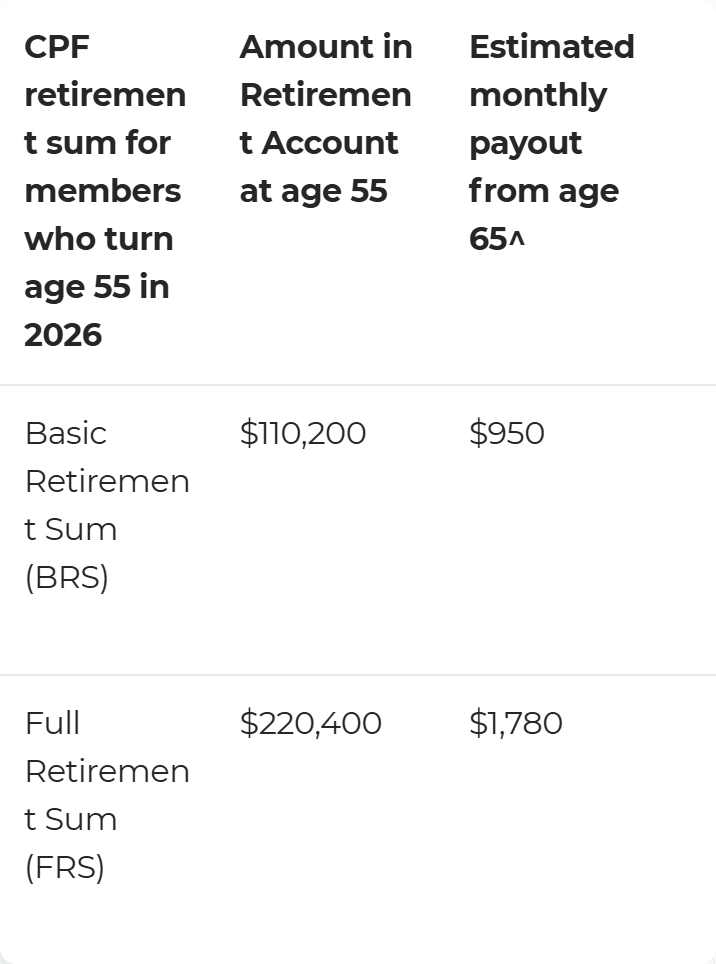
Basic Retirement Sum, $110,200
Full Retirement Sum, $220,400
Enhanced Retirement Sum, $440,800
CPF's estimates for a male member at 4% interest. Women get less on the same balance, because on average they live longer.
MoneySense describes treating CPF as "the conservative, guaranteed portion" of what you own. It also says "You may need to rebalance your portfolio to more conservative investments as you near retirement". And it warns about going too far the other way: "A 55-year-old who moves entirely to cash and bonds may underperform inflation over a 30-year retirement".
How much risk you need, can take and can live with
Jesse sizes the risk in a plan by asking about need, ability and willingness.
What it asks
What decides it
Need
How much growth your plans need
The money you'll draw each year for the life you want
Ability
How well you could recover from a loss
How much you own, and how many working years you have to make it back
Willingness
How big a swing you can live with
You alone, and it doesn't follow the other two
MoneySense puts risk appetite in terms of what you can afford to lose: "Your risk appetite is more about how much you can afford to lose rather than how much you want to make."
He works out the steady money from need first, from the withdrawals a family has planned. Whatever is left after that is money they don't need for their plans, and that's where willingness gets its say. MoneySense's rule for money you'll spend soon is the same idea: "If you have immediate needs, you should invest in liquid and low-risk assets".
A made-up example: two couples at 60
The Ongs and the Rahmans are made up, and so are their numbers. Both couples are 60, own their flat, have $600,000 saved outside CPF, and will have CPF LIFE paying both spouses from 65. Either of them could reach 90: about 4 in 10 people alive at 65 do, worked out from SingStat's 2025 life table.
The Ongs plan to draw $2,000 a month from their savings on top of CPF LIFE, so they can travel and help with their grandchildren's school fees. The Rahmans' CPF LIFE covers their everyday costs, and what they want most is to leave as much as they can to their three children.
Say a fall like the one from October 2007 to March 2009 started in their first year of retirement. Global stocks dropped 58% from top to bottom over those 16 months (MSCI's all-country world index, in US dollars). All in stocks, the Ongs would be selling shares near the bottom every month to keep paying for their plans. The Rahmans hardly touch their savings, so the same fall leaves their spending as it was.
So the Ongs start from need: the next few years of withdrawals are kept somewhere steady, and the rest stays invested for growth. The Rahmans' spending is already covered, so for them willingness decides it.

My family checklist goes through the CPF steps, nominations, the will and the LPA. The family checklist
Sources
- Google's AI Overview for "100 stock portfolio in retirement", google.com.sg, three loads captured 15 Nov 2026
- Jesse Cramer, Personal Finance for Long-Term Investors, E157, "Maximize Wealth or Minimize Risk?", 11 Nov 2026
- Anarkulova, Cederburg and O'Doherty, "Beyond the Status Quo: A Critical Assessment of Lifecycle Investment Advice", working paper, version of 6 Dec 2024
- MoneySense, life-stage investing, last updated 15 Sep 2026
- MoneySense, investment risk, last updated 19 Oct 2026
- MoneySense, options for your retirement income, last updated 4 Nov 2026
- CPF Board, CPF LIFE, last updated 12 Nov 2026
- CPF Board, what is the CPF retirement sum, last updated 20 May 2026
- CPF Board, how much CPF payouts can I get every month, last updated 16 Jun 2026
- CPF Board, how are the CPF LIFE payouts calculated, last updated 4 Mar 2026
- MSCI, ACWI Index (USD) factsheet, 30 Oct 2026
- SingStat, Complete Life Tables for Singapore Resident Population, 2024-2025, 3 Jun 2026 (2025 figures preliminary)
If you'd rather go through it with someone
Risk and financial planning with me starts with a financial audit. We go through what you already have, what's missing and the questions worth asking next. If you want advice after that, I'd do a full fact-find first, and only if you ask for one. There's no cost, and nothing changes unless you say so. I'm paid by commission or an ongoing fee if you buy anything through me, and I'll tell you that amount first, in dollars.
Lu Jia Jun · Financial Adviser Representative, GEFA · RNF No. LJJ300837068
I do not represent CPF Board, IRAS or any government agency. General information only, not financial advice.