It comes down to what the rider costs you in cash each year against what it would save you on a hospital bill, and whether you could get fuller cover back later. A rider only pays part of your share of a bill. Your Integrated Shield plan (IP) and MediShield Life stay in force without it. MOH says people should weigh "whether the very high premiums of Riders are worth the coverage it offers", and since 1 April 2026 new riders cost 35% to 40% less on average than the old ones with full coverage.
On 15 November 2026, Google's AI answer to this question said riders bought before 27 November 2025 must switch by 2028. MOH says otherwise, and the rule is below.
What each layer pays
What it does
How it's paid for
MediShield Life
Basic cover for large hospital bills, sized for subsidised B2 and C wards, for life, including pre-existing conditions
MediSave
Integrated Shield plan
Adds a private insurer's cover for higher wards or private hospitals
MediSave up to a yearly limit, the rest in cash
Rider
Pays part of the co-insurance you'd otherwise pay on a bill; older riders can also pay the deductible
Cash only
MediSave pays an IP's private part up to $300 a year at age 40 and below, $600 at 41 to 70 and $900 at 71 and above (age next birthday).
Why people are asking now
Rider premiums have grown much faster than the plans they sit on. MOH says private hospital rider premiums rose by an average of 17.2% a year from December 2021 to December 2024, against 8.6% a year for private hospital IPs. A rider's premium can reach $9,000 a year at age 70, MOH says, and it's paid entirely in cash.
Integrated Shield plans
Riders on those plans
About 182,000 policyholders downgraded or cancelled their riders in 2025, MOH says, and it doesn't track their reasons.
The April 2026 rules
Older riders
Riders sold from 1 April 2026
Covers MOH's minimum IP deductible
Can
Can't. The deductible is $1,500 to $3,500 a year by ward class
Minimum co-payment on a claim
5%
5%, unchanged
Yearly cap on that co-payment
At least $3,000
At least $6,000, not counting the deductible
The cap only applies to eligible claims, such as panel or pre-authorised ones. Riders bought before 8 March 2018 may have no co-payment.
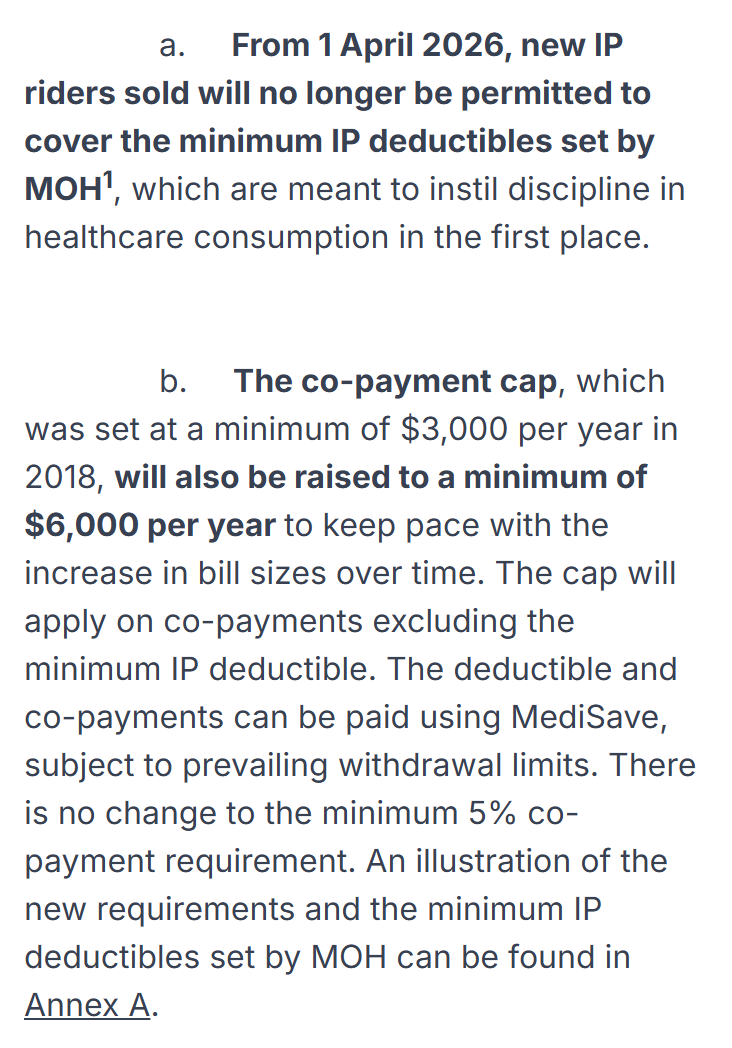
Only riders bought from 27 November 2025 to 31 March 2026 have to move to the new design, by their first renewal after 1 April 2028. For riders bought before 27 November 2025, MOH says each insurer decides its own approach, and CPF says you can keep your existing cover unless you decide to switch. Insurers must tell you about any change to your terms at least 30 days before it takes effect.
A bill with and without one
Mrs B is MOH's own example: 40, ACL surgery in a private hospital, a bill of $38,700. With a new rider, her deductible and co-payment come to $5,260, and $3,900 of it can come from MediSave.
With no rider
With a new rider
CPF's own example is on a private hospital bill of about $26,400. With the IP alone, the patient pays the $3,500 deductible plus 10% co-insurance, $5,794 out of pocket, part of which MediSave can cover.
A made-up example: Mr Ong, 55
Mr Ong is a made-up example. He's 55, has a private hospital IP and an older rider with full coverage, and is weighing his choices. On MOH's, CPF's, MoneySense's and the LIA's own pages, they look like this.
What changes
Can he go back later?
Keep the older rider
Same cover. Premiums still rise with age, and his insurer may change terms with 30 days' notice
Not needed
Switch to a new rider with his insurer
Premiums about 35% to 40% lower on average; he pays the deductible on a claim
No, older riders aren't sold from 1 April 2026. The switch itself needs no new underwriting
Drop the rider, keep the IP
No rider premium; he pays the deductible and co-insurance on a claim, part from MediSave
Fuller cover later "will typically involve underwriting", the LIA says
Move to MediShield Life only
Lowest premiums; cover sized for subsidised wards
Buying an IP again would typically involve underwriting, and its private cover may exclude conditions he has by then
CPF says the savings from a legacy rider's co-payment "can be outweighed by the extra premiums, especially if you are not hospitalised". The LIA's checklist asks whether you have an emergency fund, your family's medical history, and how a big bill would affect the people who rely on you. MOH adds that people who use subsidised public hospital wards incur smaller bills and generally don't need riders.

My family checklist goes through the CPF steps, nominations, the will and the LPA. The family checklist
Sources
- Google's AI Overview for "should i drop my integrated shield plan rider", google.com.sg, captured 15 Nov 2026
- MOH, MediShield Life, last updated 20 Feb 2025
- MOH, about Integrated Shield plans, last updated 30 Apr 2026
- MOH, new requirements for IP riders, 26 Nov 2025
- MOH, legacy rider transition and switching, 8 Sep 2026
- MOH, measures to manage IP premium increases, 6 May 2026
- MOH, IP rider changes, 2 Dec 2025
- MOH, consumer safeguards for riders, 7 Mar 2025
- MOH, trends in IP downgrades and discontinuations, 9 Sep 2026
- MOH, co-payment in IP riders, 26 Feb 2021
- CPF Board, what you can claim under MediShield Life, 7 Jul 2026
- MoneySense, Integrated Shield plans, last updated 28 Sep 2026
- LIA, making informed decisions about your healthcare coverage, 27 Apr 2026
If you'd rather go through it with someone
Risk and financial planning with me starts with a financial audit. We go through what you already have, what's missing and the questions worth asking next. If you want advice after that, I'd do a full fact-find first, and only if you ask for one. There's no cost, and nothing changes unless you say so. I'm paid by commission or an ongoing fee if you buy anything through me, and I'll tell you that amount first, in dollars.
Lu Jia Jun · Financial Adviser Representative, GEFA · RNF No. LJJ300837068
I do not represent CPF Board, IRAS or any government agency. General information only, not financial advice.