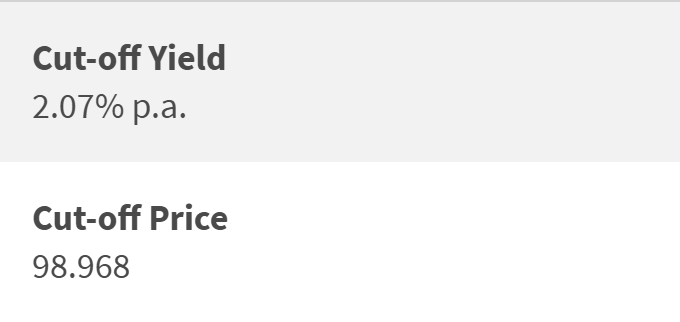
On 15 November 2026, Google's AI answer to this question opened with "Neither option is universally 'better'", then gave the latest 6-month T-bill at about 1.95% and the newest Singapore Savings Bond at about 2.45% a year over 10 years. MAS's own pages said 1.86% and 2.39% that day, and the next 6-month auction, on 19 November, came in at 2.07%. The gaps are small, and they're still the numbers you'd be choosing on.
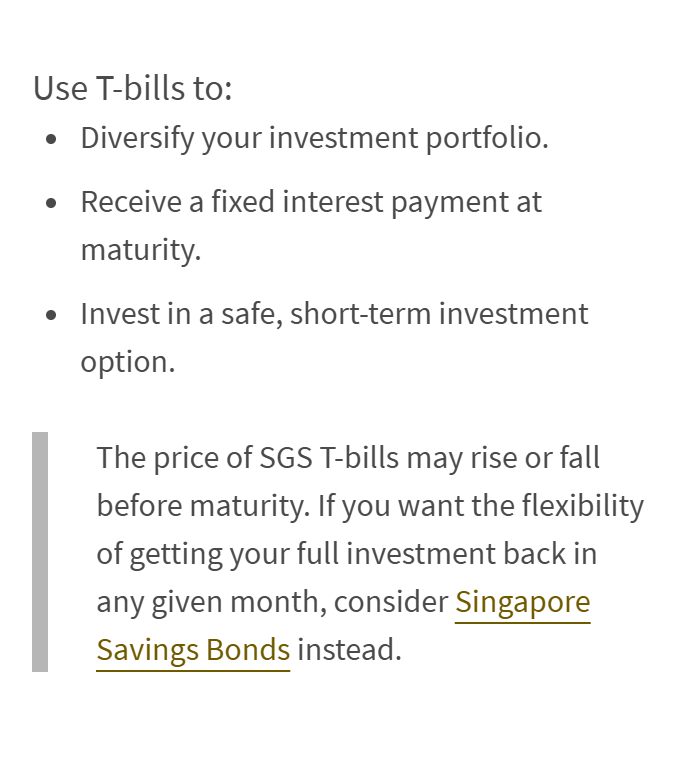
MAS answers the question by when you need the money back. On its own T-bill page it says: "If you want the flexibility of getting your full investment back in any given month, consider Singapore Savings Bonds instead."
Both are backed by the Singapore Government. A Treasury bill (T-bill) is sold below its face value for 6 months or a year, and pays the full face value on a fixed day. A Singapore Savings Bond (SSB) pays interest that steps up every year for up to 10 years, and can come back in any month with no penalty.
Two people, $20,000 each, six months
Wei and Hui are a made-up example. Each has $20,000 and the same plan: leave it for six months.
Wei buys the 6-month T-bill at the 19 November 2026 auction. MAS set the cut-off price at 98.968, so he pays $19,793.60 for $20,000 of bills, and gets $20,000 back when they mature. He earns $206.40, and interest on government securities is tax-free for individuals.
Hui puts hers in the December 2026 SSB, which pays 1.83% in its first year, if MAS allots her the full amount on 26 November. Six months of that on $20,000 is about $183. Her bank charges $2 to buy and $2 to redeem, so she ends up with about $179.
6-month T-bill, auction of 19 November 2026
December 2026 Savings Bond, redeemed after six months
The SSB figure is half of its 1.83% first-year rate, less the $2 fee to buy and the $2 fee to redeem.
Over six months the T-bill pays about $27 more.
When the plan changes in month three
Now say both of them need the money back in February.
Hui asks for it in February and pays the $2. MAS says her money and the interest built up so far arrive by the second business day of the next month, so early March.
Wei can't redeem his bill early. He can sell it at the main branch of one of the three local banks, at the market price, and MAS says that price may be more or less than he paid. That's the flexibility MAS's own page points to.
MAS's own pitch for the SSB is a rainy-day fund, with "the flexibility to access your funds within a month". It also says that if you redeem early, "you will receive a lower return" than holding the full 10 years.
If both keep going
Hui's December 2026 bond pays 2.39% a year on average if she keeps it the full 10 years. Applications close on 25 November 2026, and she can hold from $500 up to $200,000 in SSBs.
Wei's rate is reset at every auction. If he rolls his bills over, he takes whatever the next auction gives.
2 January 2025
6 November 2025
12 February 2026
4 November 2026
19 November 2026
Each new 6-month auction changes the latest figure, so check MAS's auction page.
So the T-bill rate is up on November 2025, and still about a third below January 2025. A year earlier, the December 2025 SSB paid 1.35% in its first year and 1.85% a year over 10.
The other places cash sits
6-month T-bill
Singapore Savings Bond
12-month fixed deposit
Who backs it
The Singapore Government
The Singapore Government
The bank, and SDIC up to $100,000 per person per bank
Latest rate
2.07% a year, auction of 19 November 2026
1.83% in year 1, 2.39% a year on average over 10 years (December 2026 issue)
Three banks' November 2026 promos ran from 1.70% to 2.30%, from $10,000 or $20,000 up
Smallest amount
$1,000
$500
Set by each bank
Getting it back early
Can't be redeemed; sell at a bank branch at the market price
Ask in any month, no penalty, $2 bank fee; the money lands early the next month
One bank's November promo pays no interest at all if you break it
Paying with CPF or SRS
Cash, SRS, or CPF (Ordinary Account above $20,000, Special Account above $40,000)
Cash or SRS; CPF can't be used
Cash, or SRS at some banks; one bank's 12-month promo doesn't take SRS funds
A fixed deposit is covered by SDIC, the deposit insurer, up to $100,000 per depositor per bank, with your Singapore dollar savings and current accounts at that bank added in. Board rates and promotions are far apart: at one local bank on 20 November 2026 the standard 12-month rate was 0.05% a year from $20,000 up. Bonus-interest savings accounts also start at 0.05%, and the higher rates come with conditions such as crediting your salary and spending on the bank's card.
If the money is in your CPF Ordinary Account, it already earns 2.5% a year from 1 October to 31 December 2026, its legal minimum, which is more than the 19 November 6-month T-bill. MAS's page on buying at auction says, in its note on CPF money: "The prevailing CPF interest rates may be higher than the yield on SGS."
Money with a date
MoneySense says to set aside 3 to 6 months of expenses as an emergency fund. That money has no date, and MAS's own rainy-day pick, the SSB, comes back within a month. Money with a date, like school fees next June or a flat downpayment due when the keys are ready, can wait in something that ends on that date.

My PROTECT checklist goes through your money if your job goes: what to have ready before, on the day you're told, and in the first 30 days. The PROTECT checklist
Sources
- Google's AI Overview for "is T-bill or SSB better", google.com.sg, captured 15 Nov 2026
- MAS, T-bills for individuals, last updated 17 Jul 2026
- MAS, compare products for individuals, last updated 28 Jul 2026
- MAS, how SGS auctions are conducted, last updated 17 Apr 2025
- MAS, buying SGS bonds and T-bills at auction, last updated 17 Jul 2026
- MAS, selling SGS bonds and T-bills on the secondary market, last updated 2 Oct 2023
- MAS, T-bill FAQs, last updated 29 Sep 2025
- MAS, 6-month T-bill auction of 19 Nov 2026, read 20 Nov 2026
- MAS, 6-month T-bill auction of 4 Nov 2026
- MAS, 6-month T-bill auction of 6 Nov 2025
- MAS, 6-month T-bill auction of 2 Jan 2025
- MAS, 6-month T-bill auction of 12 Feb 2026
- MAS, Singapore Savings Bonds, last updated 17 Jul 2026
- MAS, investing in Singapore Savings Bonds, last updated 11 Aug 2026
- MAS, December 2026 Savings Bond
- MAS, December 2025 Savings Bond
- MAS, how to buy and how to redeem Savings Bonds, last updated 17 Jul 2026 and 27 Oct 2023
- SDIC, deposit insurance FAQ and scope of coverage, read 20 Nov 2026
- CPF Board, earning attractive interest, last updated 16 Nov 2026
- CPF Board, investing your CPF savings, last updated 27 Aug 2026
- MoneySense, managing your money, last updated 28 Sep 2026
- Banks' own fixed deposit and savings account pages, read 20 Nov 2026
If you'd rather go through it with someone
Risk and financial planning with me starts with a financial audit. We go through what you already have, what's missing and the questions worth asking next. If you want advice after that, I'd do a full fact-find first, and only if you ask for one. There's no cost, and nothing changes unless you say so. I'm paid by commission or an ongoing fee if you buy anything through me, and I'll tell you that amount first, in dollars.
Lu Jia Jun · Financial Adviser Representative, GEFA · RNF No. LJJ300837068
I do not represent CPF Board, IRAS or any government agency. General information only, not financial advice.