On 15 November 2026, Google's AI answer to this question in Singapore opened with "Neither option is universally 'better'". On that much it agrees with MoneySense, the Government's financial education site, which tells you to "compare both types of products as each product fulfils a specific purpose".
That's a fair answer, and it still leaves you without a number to decide on. So take one person, put MoneySense's own rules and prices against her, and see where the choice sits.
What each one is
Term life pays out on death or total and permanent disability, and only inside the years it covers. The premium stays level for the term, and if you renew, the insurer re-prices it by your age then. MoneySense says that renewal price isn't guaranteed and can rise a lot as you get older. Whole life covers you for life and builds a cash value, which MoneySense says is why it generally costs more. On participating plans the projected bonuses aren't guaranteed.
Ann, 30, earning $5,000 a month
Ann is a made-up example. She's 30, earns $5,000 a month, or $60,000 a year, and has a young child.
MoneySense's rule of thumb, worked out by the Life Insurance Association (LIA), is cover of 9 times your yearly income for death and total and permanent disability, and 4 times for critical illness. For Ann that's $540,000 and $240,000.
Death and total and permanent disability, 9 times income
Critical illness, 4 times income
CPF's Dependants' Protection Scheme, to age 60
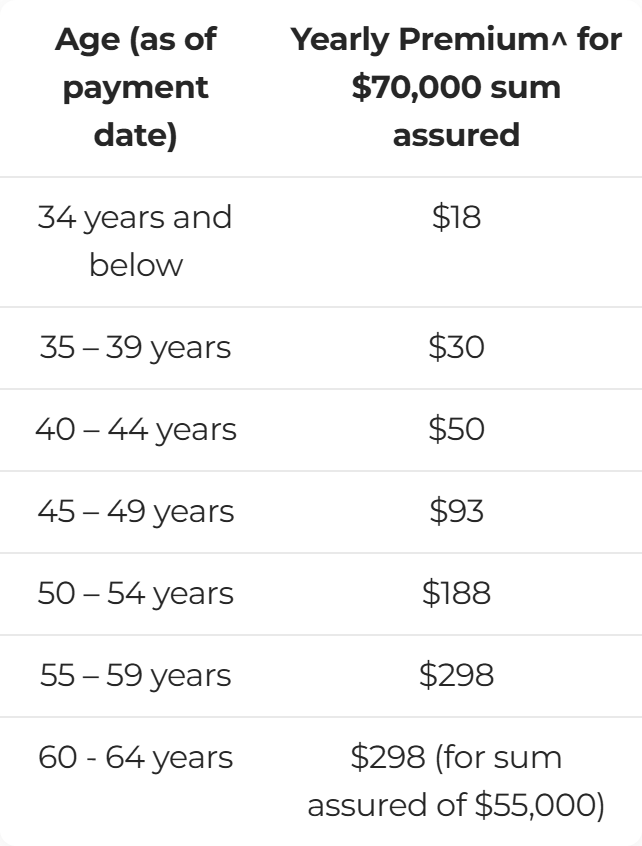
Some of it is already in place. Her first working CPF contribution put her on CPF's Dependants' Protection Scheme (DPS) unless she opted out. It's term cover of up to $70,000 until 60, and up to $55,000 from 60 to 65, and at her age the premium is $18 a year, paid from her CPF. MoneySense calls it money "to tide them over the first few years".
That leaves about $470,000 of death cover to find. The LIA says her savings count toward it as well as her insurance. Its last Protection Gap Study (2022, published September 2023) found that, added up across all working adults, savings and insurance cover about 79% of what families would need if the earner died.
34 and below
35 to 39
40 to 44
45 to 49
50 to 54
55 to 59
From 60 to 64, the premium is $298 for $55,000 of cover. It's paid from CPF and renews every year until the 65th birthday.
What her budget allows
MoneySense also says to spend at most 15% of take-home pay on protection. After her 20% CPF contribution, Ann takes home about $4,000 a month before income tax, so her ceiling is about $600 a month.
MoneySense's "Starting a family" guide prices term cover for a 30-year-old woman at about $23 a month for $300,000 of cover to age 65. That's its estimate of the median price on compareFIRST, the comparison portal it points you to, and it's for $300,000, less than the $470,000 above.
Take-home pay, after her 20% CPF contribution
MoneySense's ceiling for protection, 15% of take-home
Median term price for $300,000 of cover to 65, less than her $470,000 gap
The $23 is MoneySense's estimate for a 30-year-old woman. compareFIRST shows term and whole life prices once you enter your date of birth, gender, smoker status and the cover you want.
Whole life costs more for the same cover. MoneySense's FAQ on basic financial planning says bundled plans such as whole life "may exceed 15% of take-home pay", because they mix protection with investing, and says not to be alarmed if your policies together cost more than 15%. There's no published median whole-life price to put beside the $23, so the only fair comparison is the one compareFIRST gives Ann for her own details.
Term isn't always the cheaper one either. MoneySense says a term plan can cost more than a bundled plan when it pays a higher death benefit or runs for longer.
How long her child needs the cover
Price only answers half of it. Before whole life, MoneySense asks whether your dependants need you for the rest of your life, or until they can support themselves. Its own example of when term fits is cover "until your youngest child completes university or is financially self-reliant".
If Ann wants the money there until her child can stand alone, a term plan that runs to that year matches it. If she wants it to reach her child whenever she dies, even at 90, that's the case MoneySense makes for cover that lasts for life.
Side by side, one thing at a time
Term life
Whole life
How long it covers you
A fixed period, from five to 40 years
For life
Cash value
Typically none
Builds up, because part of each premium is invested
Price for the same cover
Usually cheaper
Generally costs more
When you renew
Re-priced by your age then; not guaranteed
No renewal; cover runs for life
If you end it early
Cover stops; there's usually nothing to get back
MoneySense: "early termination may result in losses"
If the insurer fails
Guaranteed benefits, up to S$500,000 of sum assured per life insured per insurer
The same, plus up to S$100,000 of guaranteed surrender value; projected bonuses aren't covered
The SDIC caps are shared by all your policies with the same insurer.
If you change your mind, every life insurer gives you at least 14 days from the day you get the policy documents. Cancel inside them and the insurer refunds your premiums, less any medical and other costs it has paid. MoneySense suggests looking at your cover again every two years, or when something big happens, like the birth of your first child.

My family checklist goes through the CPF steps, nominations, the will and the LPA. The family checklist
Sources
- Google's AI Overview for "is it better to have term life or whole life insurance singapore", google.com.sg, captured 15 Nov 2026
- MoneySense, term vs whole life, last updated 28 Sep 2026
- MoneySense, term insurance, last updated 28 Sep 2026
- MoneySense, understanding whole life insurance, last updated 28 Sep 2026
- MoneySense, life insurance, last updated 28 Sep 2026
- MoneySense, planning your finances well, last updated 16 Oct 2026
- MoneySense, Your Financial Basics: Starting a Family, PDF, 2026
- MoneySense, FAQs on basic financial planning, PDF
- MoneySense, interpreting your insurance documents, last updated 11 May 2026
- LIA, Protection Gap Study 2022 key findings, 8 Sep 2023
- CPF Board, DPS premiums by age, read 15 Nov 2026
- CPF Board, DPS administrator contract to 2028, 26 May 2025
- CPF Board, contribution rates, read 15 Nov 2026
- SDIC, Policy Owners' Protection Scheme entitlement, read 15 Nov 2026
- compareFIRST glossary, read 15 Nov 2026
If you'd rather go through it with someone
Risk and financial planning with me starts with a financial audit. We go through what you already have, what's missing and the questions worth asking next. If you want advice after that, I'd do a full fact-find first, and only if you ask for one. There's no cost, and nothing changes unless you say so. I'm paid by commission or an ongoing fee if you buy anything through me, and I'll tell you that amount first, in dollars.
Lu Jia Jun · Financial Adviser Representative, GEFA · RNF No. LJJ300837068
I do not represent CPF Board, IRAS or any government agency. General information only, not financial advice.