Everyone wants a good adviser. Almost nobody wants to be a good client.

Sit in on any kopitiam conversation about money and you'll hear the stories. The adviser who vanished after the policy was signed. The one who pushed whatever paid best that quarter. The one who couldn't explain his own product without reading the brochure. Every story stars a bad adviser.
Fair enough. My industry earned that reputation, and I've written plenty here about how.
But after enough first meetings, I've noticed the conversation nobody wants to have. A good outcome needs two people doing their jobs. Plenty of people who want a brilliant adviser have no intention of being a workable client.
What does that look like in practice? It looks like showing me two policies when there are five in the drawer. It looks like leaving out the personal loan, the "small" trading account that lost forty percent, the other adviser you're also talking to. It looks like asking for discipline in a calm October and fighting every rule by a red March. It looks like ticking "aggressive" on the risk questionnaire, then calling in a panic at minus fifteen percent. (I don't take the panic personally. Panic is human. The questionnaire answer that ignored it is the expensive part.)
Here's the comparison I keep coming back to. You wouldn't describe half your symptoms to a doctor and expect a useful diagnosis. Yet people routinely hand advisers half their financial life and expect a plan that works. A fact-find with half the facts produces advice calibrated for a person who doesn't exist.
Be honest with yourself for a moment. The last time someone asked you a hard question about your money, did you give the real answer, or the presentable one?
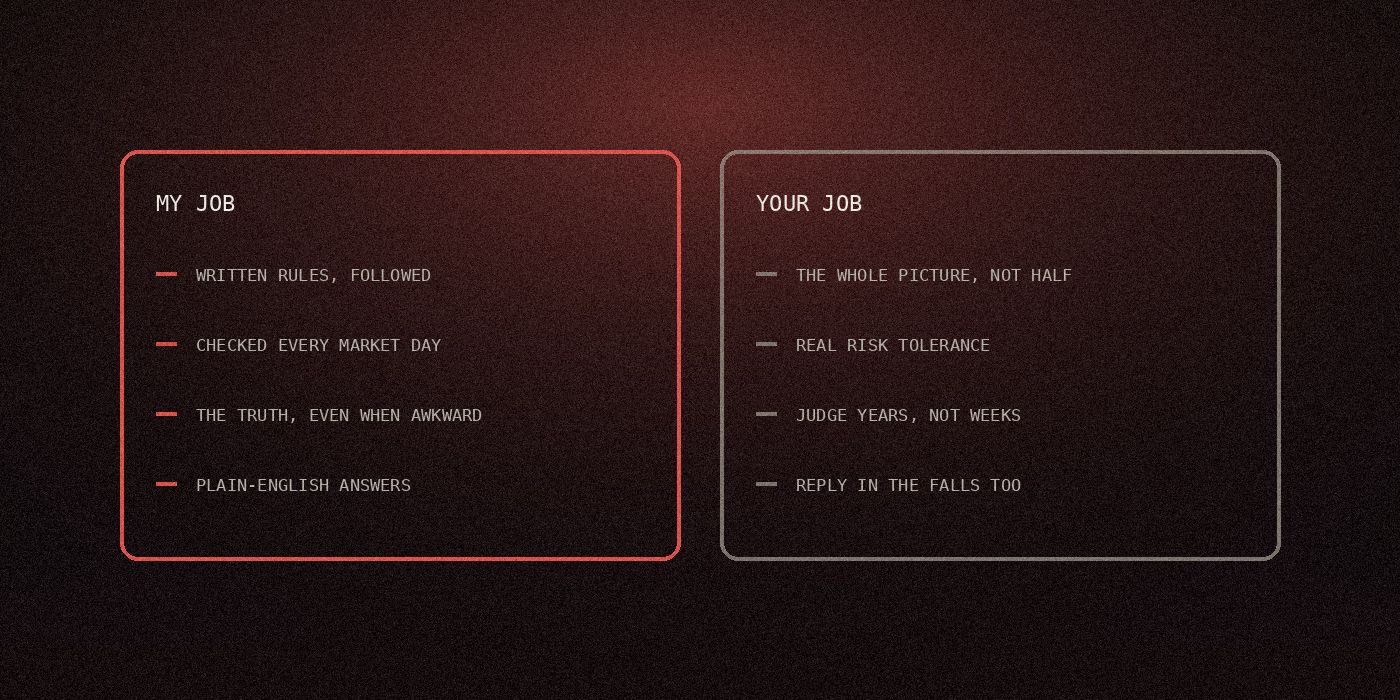
So what does a good client actually do? Brings the whole picture, including the embarrassing parts. Gives the real answer on risk, not the brave one. Replies to messages in falling markets, not only rising ones. Judges the process over years, not over the first red quarter. And says "I don't understand, explain it again" as many times as it takes, because confusion you hide becomes consent you didn't mean to give. Notice that none of this requires financial knowledge. It requires honesty and a little patience.
Now the part my industry won't say: the responsibility still tilts our way, because good clients are usually made, not born. If you've never been one, perhaps nobody ever asked you real questions, explained things until they stuck, or showed you written rules worth trusting. It's hard to be honest with an adviser who calls twice a year to sell. My PEAK framework runs on honest inputs, your actual risk tolerance, the full map of what you hold. Feed it a flattering version of yourself and it will discipline-manage a stranger's portfolio.
So here's the deal I offer, stated plainly. I bring written rules, daily monitoring, answers in plain English, and the truth even when it's awkward. You bring everything in the drawer and the real version of yourself, including the part that panics. That trade has to feel fair from both chairs.
If it does, the first conversation is free, and it works best when you bring the policies you almost didn't mention.
Every insight here is written or reviewed by me before it publishes. If it carries my name, I have read every word.